
About Me. 👋
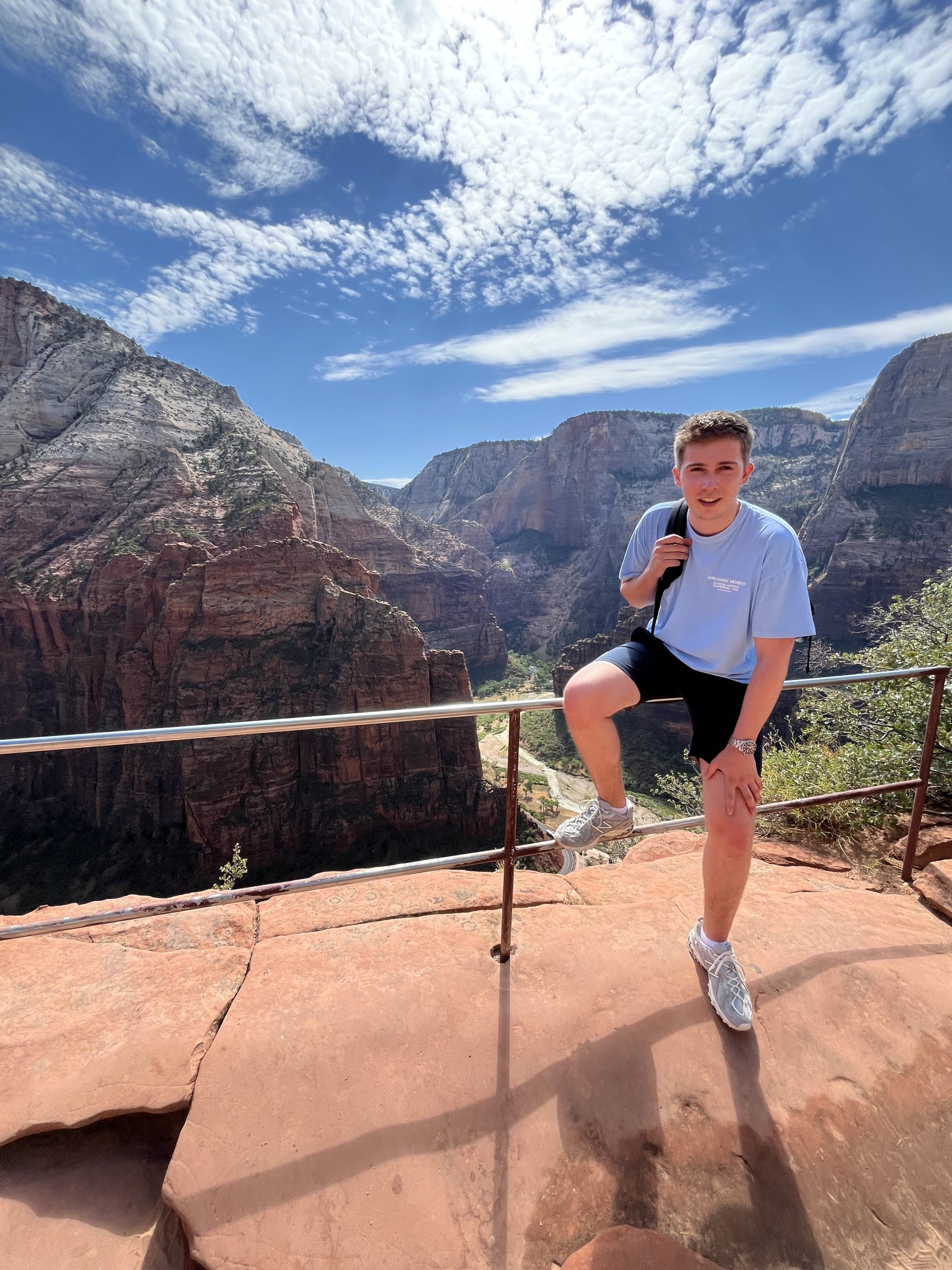
Hello, I’m Rick van Giersbergen — a first-year Masters Industrial Design student at the Technical University of Eindhoven in the Netherlands. I’m a passionate advocate for the intersection of Design, Business Innovation, Entrepreneurship and Technology. I’m driven by the potential to create impactful solutions that combine creative design thinking with practical business strategies. I aim to explore how emerging technologies can shape the future of products and services, and how entrepreneurial ventures can bring innovative ideas to life in the real world.
Professional Identity
As an Industrial Designer, my professional identity is shaped by a passion for learning and a never-ending pursuit of knowledge across diverse domains. I strive to be a designer who envisions beyond conventional boundaries, constantly seeking to explore and understand a broad range of topics in the areas of technology, society and art. For instance, during my FBP I delved into the yet
underexplored intersection of AI and education, designing a novel toolkit used to demystify AI and provide children with the tools to navigate this increasingly AI-driven world.
A designer needs to be able to take into account as many components of the design as possible. This means being creative, having a human-centered approach and the ability to identify opportunities that others might overlook. This last part is not just that of a designer but also that of an entrepreneur. A good designer is someone who can not only create valuable designs but also bring those designs to market, either by starting their own company or by collaborating with existing companies. This ensures that designs not only offer research value but also make a real-life impact on the people who use them.
“A designer is someone who can envision beyond where most people pause their thinking’’
I have a strong curiosity that drives me to connect conceptual design with research-focused frameworks. I feel most at ease where design meets technology, particularly in emerging areas like artificial intelligence. My interest is centered around large language models (LLM’s) and generative AI systems, which captivate me not only for their innovative aspects but also for their potential to reshape how individuals learn, explore ideas and engage with intricate topics. Rather than just seeing these technologies as ways to improve efficiency, I am more interested in their ability to foster reflection, creativity and self-directed exploration.
Additionally, my focus has been shifting toward business and entrepreneurship. I aim to understand how design can function as an independent and viable practice instead of being purely theoretical. Throughout my academic journey, I have studied business, innovation strategy and leadership. This has helped me recognize how design intentions can be translated into value propositions, build client relationships and shape organizational structures.
During the earlier stages of my education, I noticed that I often sought clarity too soon in the design process, delaying action until I felt a direction was clear. In my recent research project and the M21 Preparation FMP , I took it upon myself to challenge this tendency. I chose to embrace uncertainty for a longer period and started incorporating making into the early stages as a form of thinking. This change has transformed my practice, boosting my confidence in navigating ambiguity and using prototyping as a means of exploration rather than just a final execution.
Right now, my primary limitation does not stem from my exploratory design skills but it arises from the lack of external validation for my entrepreneurial ambitions. Although I have built a conceptual framework for my design studio and methodology, many of my assumptions remain untested. I need to understand whether clients value this approach, if the studio can function effectively in real-life situations and whether its offerings can succeed outside of an academic environment. Addressing this gap is a key motivator for my Final Master Project, which I see as an opportunity to pursue paid client work and carefully evaluate the practicality of my design practice in a real-world context.
As I look to the future, my focus is on developing a sustainable and research-oriented design practice. My immediate goal is to establish my own design studio that functions at the intersection of aesthetics, education and emerging technologies. In this context, I plan to assess conceptual design work through actual client projects and their execution. At the same time, I intend to pursue an Engineering Doctorate (EngD) after I finish my Master’s degree. I see the EngD as an opportunity to improve the methodological and technological rigor of my work within a hands-on, industry-focused R&D setting. Together, these aims embody a long-term vision where practice and research continually inform each other. The design studio serves as a space for experimentation and validation, while the EngD provides the analytical foundation necessary to enhance and develop that practice over time.
Vision
My vision as an Industrial Designer is based on the idea that technological advancement is progressing faster than our collective ability to understand, question and incorporate it into our everyday lives. As systems like artificial intelligence become more embedded and complex, the real challenge shifts from just technological progress to helping people actively engage with these systems, learn from them and assert their agency within them. I believe that design plays a crucial role in facilitating this engagement.
I view myself as a constructivist designer, believing that understanding cannot be handed over but must be cultivated through interaction, exploration and reflection [1]. Instead of trying to reduce complexity to simple solutions, my goal is to create environments where individuals can build their own understanding. This viewpoint was influenced by my Final Bachelor Project, where I examined how children could interact with artificial intelligence through playful, modular activities. I built upon this idea during my Preparation FMP (M21), refining my design practice to focus on ambiguity, aesthetics and early making as key elements of the learning process.
At the heart of my vision is the significance of curiosity as a crucial element for engagement. I believe that true learning takes place when people are inspired to explore, question and accept uncertainty rather than being hurried toward quick fixes. In this context, design transforms from merely providing efficient solutions to creating experiences that encourage deeper interaction and engagement. Aesthetics, materiality and interaction are not simply decorative aspects but they are vital tools that help sustain this engagement.
I imagine a future in which design extends beyond merely optimizing interfaces for usability and instead nurtures deeper understanding and reflection, especially in educational contexts and in relation to emerging technologies like artificial intelligence. Through Studio DRIBB, I aim to create artifacts and experiences that function as conceptual learning tools. Objects that are both approachable and captivating at first glance but reveal greater complexity through their use.
Ultimately, my objective is to foster a design practice that embraces ambiguity as an opportunity for engagement rather than a. problem to avoid. By focusing on design that encourages exploration rather than simple instruction and on construction instead of consumption, I aim to contribute to a future where people are more capable of navigating, questioning and engaging with an increasingly complex technological landscape.